

Understanding Premises Liability in Georgia
Property owners have a legal duty to maintain safe conditions for visitors. Under Georgia law, this responsibility falls under premises liability, which holds property owners accountable when their negligence causes injuries to others. According to the Centers for Disease Control and Prevention, there are about 3 million emergency department visits due to falls each year, with many occurring on commercial properties.
The level of care a property owner must provide depends on your status as a visitor. Invitees, such as customers in a store, are owed the highest duty of care. Property owners must regularly inspect their premises, identify potential hazards, and either fix dangerous conditions or provide adequate warnings. Licensees, who have permission to be on the property for their own purposes, are owed a duty to warn about known hazards. Trespassers are generally owed no duty of care, with limited exceptions.
Common Hazards That Cause Commercial Property Accidents
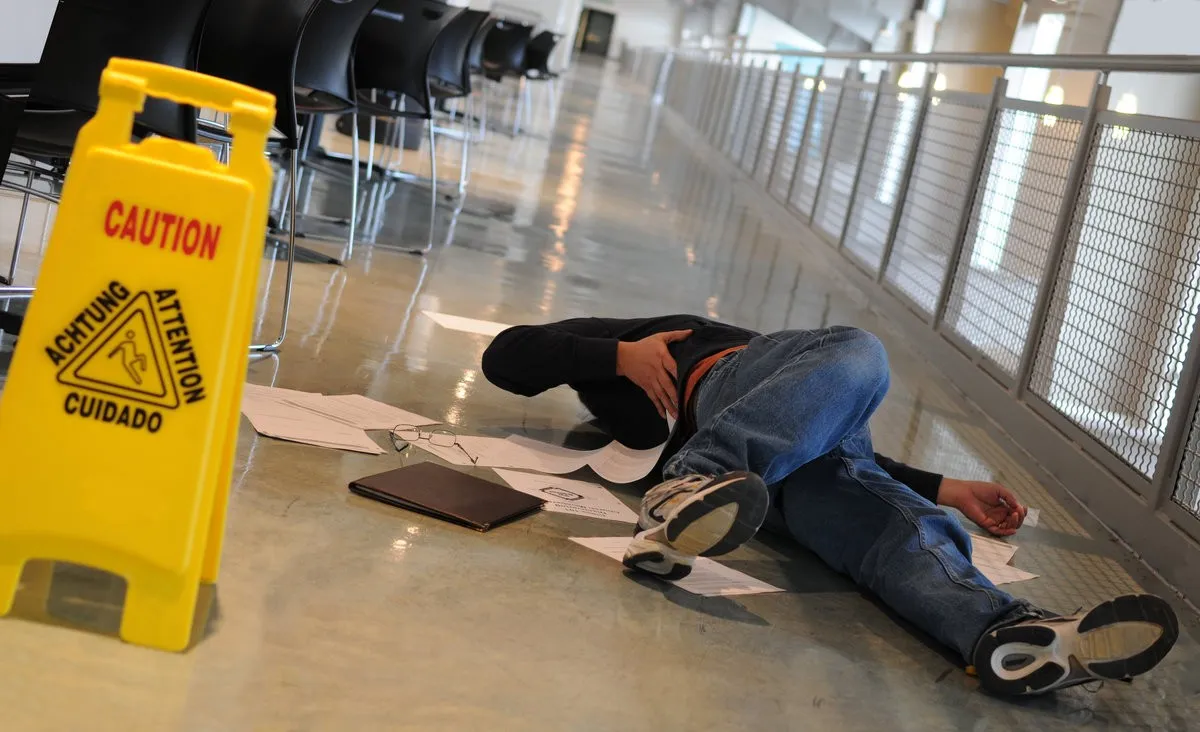
Slip and fall accidents on commercial property often result from preventable hazards. Wet or slippery floors are among the most frequent causes, whether from recent mopping, spills, leaks, or tracked-in rain or snow. Uneven walking surfaces, including cracked sidewalks, broken tiles, potholes in parking lots, and transitions between different flooring materials, create tripping hazards that property owners must address.
Poor lighting in stairwells, parking lots, and walkways makes it difficult for visitors to see potential dangers. Cluttered walkways with merchandise, equipment, or debris create obstacles that can cause serious falls. Missing or damaged handrails on stairs and ramps remove crucial safety features. Additionally, worn or torn carpeting and floor mats can catch shoes and cause people to trip. When property owners fail to maintain their premises or warn visitors about these hazards, they may be held liable for resulting injuries.
Proving Your Slip and Fall Case
Successfully pursuing a slip and fall claim requires establishing several key elements. You must demonstrate that the property owner knew or should have known about the dangerous condition. This knowledge can be actual, meaning they were directly aware of the hazard, or constructive, meaning the condition existed long enough that a reasonable inspection would have discovered it.
Next, you must show that the property owner failed to take reasonable steps to fix the hazard or warn visitors about it. The dangerous condition must have directly caused your fall and subsequent injuries. Finally, you need to prove that you suffered actual damages, including medical expenses, lost wages, pain and suffering, or permanent disability.
Evidence plays a vital role in slip and fall cases. Photographs of the accident scene, including the hazard that caused your fall and the surrounding area, provide crucial documentation.
Incident reports filed with the property owner or manager create an official record. Witness statements from people who saw your fall or were aware of the dangerous condition support your version of events. Medical records documenting your injuries and treatment establish the extent of your damages. Maintenance and inspection logs may reveal whether the property owner knew about the hazard or failed to conduct proper inspections.
Time Limits for Filing Your Claim
Georgia law imposes strict deadlines for filing personal injury claims. Under the statute of limitations, you generally have two years from the date of your accident to file a lawsuit. Missing this deadline typically means losing your right to seek compensation, regardless of how strong your case may be.
However, certain circumstances can affect this timeline. If you were injured as a minor, the statute of limitations may not begin until you turn 18. Claims against government entities often have much shorter notice requirements, sometimes as brief as six months. These shortened timeframes make it imperative to consult with an attorney as soon as possible after your accident.
Compensation Available in Slip and Fall Cases
Victims of commercial property slip and fall accidents may recover various types of compensation. Economic damages include all quantifiable financial losses such as past and future medical expenses, lost wages and reduced earning capacity, costs for rehabilitation and therapy, medical equipment and assistive devices, and home modification expenses if your injury results in permanent disability.
Non-economic damages compensate for intangible losses that are more difficult to quantify but equally real. These include physical pain and suffering, emotional distress and mental anguish, loss of enjoyment of life, and permanent scarring or disfigurement. In cases involving particularly egregious conduct by the property owner, such as knowingly allowing a dangerous condition to persist despite awareness of the risk, Georgia law may allow for punitive damages designed to punish the wrongdoer and deter similar conduct.
Why Choose Taylor Odachowski Schmidt & Crossland, LLC
The attorneys at Taylor Odachowski Schmidt & Crossland, LLC, bring decades of combined experience to every personal injury case we handle. Our team understands the complexities of premises liability law in Georgia and knows how to build strong cases that demonstrate property owner negligence. We work with medical experts, accident reconstruction specialists, and other professionals to thoroughly document your injuries and establish the full value of your claim.
Our approach focuses on your unique needs and circumstances. We take time to understand how your accident has affected your life, your ability to work, and your future prospects. This comprehensive perspective allows us to pursue maximum compensation that addresses not just your immediate expenses but also your long-term needs. If you’ve been injured in a slip and fall accident on commercial property, contact our office to schedule a consultation and learn how we can help you pursue the compensation you deserve.
