

Think about everything you own online: bank accounts you access through an app, a cryptocurrency wallet, years of photos stored in the cloud, social media profiles, streaming subscriptions, even a small side business run through a website. When you pass away, none of that simply transfers to your loved ones the way a physical piece of property might. Without deliberate planning, much of it may be permanently lost, frozen, or deleted altogether.
At Taylor Odachowski Schmidt & Crossland, LLC, we help clients throughout coastal Georgia take a complete approach to estate planning, one that accounts for the digital lives most of us now lead alongside our physical assets. The reality is that digital assets can hold significant financial and personal value, and the law governing what happens to them at death is more nuanced than many people realize. Understanding your options is the first step toward protecting what you’ve built.
What Counts as a Digital Asset
The term “digital asset” covers far more ground than most people initially consider. At a basic level, the IRS defines digital assets as digital representations of value recorded on a cryptographically secured distributed ledger or similar technology, a definition that includes cryptocurrency, non-fungible tokens (NFTs), and stablecoins. But for estate planning purposes, the category is considerably broader.
Digital assets relevant to your estate plan may include online banking and investment accounts, PayPal and Venmo balances, cryptocurrency wallets and private keys, reward and loyalty points, email accounts, social media profiles, digital photo libraries, domain names, online businesses, and any intellectual property stored or sold online. Each of these carries its own rules about who can access it after you’re gone and under what conditions. Some platforms will permanently delete an account if no authorized representative steps forward in time. Others may require a court order before granting access to anyone.
How Georgia Law Addresses Digital Assets
Georgia enacted the Revised Uniform Fiduciary Access to Digital Assets Act (RUFADAA) in 2018, giving executors and trustees a legal framework for managing digital property after a person’s death or incapacitation. Before this law existed, families and fiduciaries were largely left to navigate the terms-of-service agreements of individual platforms, terms that often prohibited account access by anyone other than the original user, even after death.
Under Georgia’s RUFADAA, the hierarchy of control works in this order. First, any online tool provided by the platform itself, such as Google’s Inactive Account Manager or Facebook’s Legacy Contact feature, takes priority. Second, instructions you leave in your will, trust, or power of attorney govern access. Third, if you’ve left no instructions at all, the platform’s own terms of service apply by default, which may result in your family receiving no access whatsoever.
One critical limitation: RUFADAA grants fiduciaries access to manage digital assets, but it does not automatically authorize access to the content of private communications like emails or direct messages. Unless you have explicitly granted that permission in your estate planning documents, your executor may be limited to basic account management functions only.
The Problem with Cryptocurrency
Cryptocurrency deserves special attention in any digital estate plan because it operates differently from every other type of asset. Unlike a bank account, there is no institution that can reset your password or restore access for a surviving family member. If your private keys or seed phrases are lost, the cryptocurrency is gone permanently. No court order or legal authority can recover it.
The use of cryptocurrency in estate plans has grown dramatically in recent years, making this one of the most urgent digital planning issues for many Georgia families. To protect these assets, your estate plan should document where your cryptocurrency is held, how wallets are organized, and where access credentials are stored securely. A living trust is particularly useful for cryptocurrency because it allows for private, efficient transfer to beneficiaries without the delays of probate, and without exposing sensitive wallet information in a public court proceeding.
What You Can Do to Protect Your Digital Estate
Addressing digital assets in your estate plan does not have to be complicated, but it does require intentional steps beyond what a standard will typically covers.
Here are the key actions worth taking now:
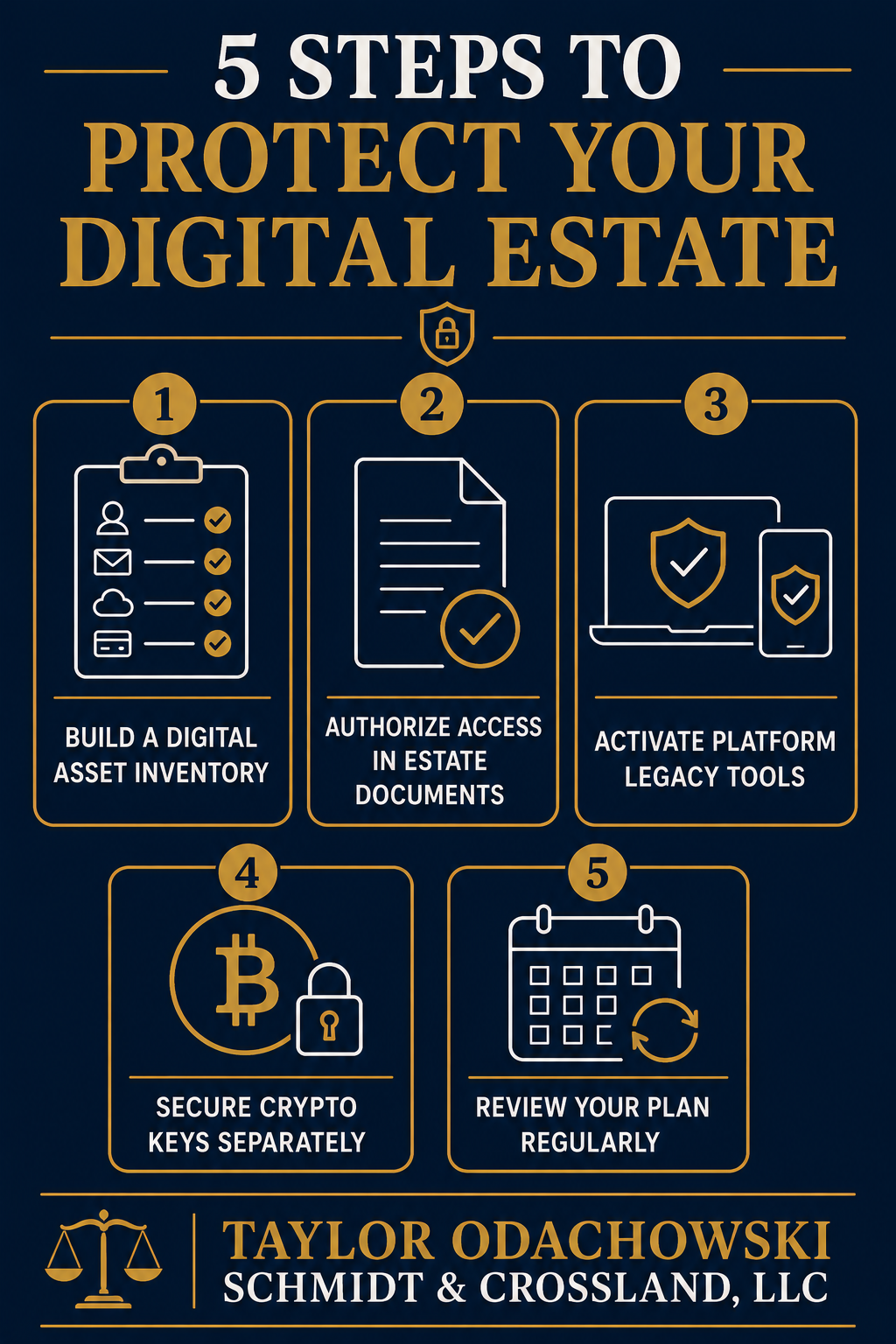
- Create a digital asset inventory: List every significant account, platform, and digital holding you own. Include usernames and document where access credentials are stored, in a password manager, a sealed letter, or a secure document your executor can locate.
- Include explicit authorization in your estate documents: Your will, trust, or durable power of attorney should specifically grant your fiduciary the authority to access, manage, and distribute your digital assets. Vague language is often insufficient under RUFADAA.
- Use platform legacy tools where available: Services like Google, Apple, and Facebook offer built-in tools that let you designate what happens to your account after death. These tools take legal priority over your estate documents under Georgia law, so keeping them updated matters.
- Secure cryptocurrency access separately: Store private keys, seed phrases, and hardware wallet instructions in a way that is accessible to your executor but protected from unauthorized access during your lifetime.
- Review your plan regularly: Digital asset portfolios change frequently. What you owned online three years ago may look very different today, and your estate plan should reflect those changes.
Keeping your estate planning documents current is one of the most important things you can do to protect your digital legacy and the people you’ll leave behind.
Contact Taylor Odachowski Schmidt & Crossland, LLC
Digital assets are no longer a fringe concern in estate planning; they represent real value that families can lose permanently without the right legal protections in place. Whether you are building a comprehensive estate plan for the first time or updating an existing one to account for assets you’ve accumulated online, Taylor Odachowski Schmidt & Crossland, LLC is ready to help. Our attorneys have spent decades guiding clients throughout Brunswick, St. Simons Island, and the Golden Isles through complex estate planning decisions, and we bring that same depth of experience to every digital estate matter we handle.
Our Martindale-Hubbell AV™-rated firm takes pride in delivering thoughtful, practical counsel tailored to each client’s circumstances. If you’re ready to make sure every part of your estate, including your digital life, is protected, reach out through our contact form today.
